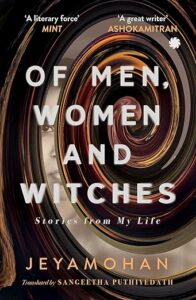
“Even though my mother had a lilting voice, she never sang,” begins author Jeyamohan’s memoir Of Men, Women and Witches: Stories from My Life.
Jeyamohan is not just an ordinary author writing bestsellers. He is The Master of fiction, a wizard of words who doesn’t merely write stories but casts spells with sentences, weaving worlds we never wish to leave.
His memoir is no different from his exquisite fictions. One moment you’re on your couch opening the book, the next you are transported into a world full of Yakshis (magical Kerala goddesses akin to fairies), snakes curled inside screwpine flowers, and air heavy with the scent of champak blossoms.
The memoir blurs the line between fiction and reality in many places, especially in the fifth chapter. But these narratives are necessary to give a glimpse into the authentic life and beliefs of Nanjil Nadu and the childhood of the author.
Of Men, Women and Witches: Stories from My Life is a must-read for the following reasons if you love history:
• It offers rich, detailed accounts of the micro-history of Nanjil Nadu and Marthanda Varma, its first truly great leader.
• The book paints a vivid picture of the geography of Nanjil Nadu — its winds, vegetation, the life of its people, their loyalty to the kings and the palace, and more.
• The memoir captures how a once lush land filled with mangoes, coconut trees, and jackfruits dwindled before the author’s eyes, exploited by rubber farms.
Even seemingly mundane things, like a simple annual festivity to a forgotten god in a forest, turn magical and extraordinary under his enchanting descriptions of Yakshis. In a way, these Yakshis transform into various women in his life.
Imagery Created by a Master Illusionist
The innocent and childlike Karadi Nayar, familiar to his readers through his short stories, takes the role of a compassionate father and a Byronic antihero in this memoir. The author’s troubled relationship with his tempestuous father is expressed in carefully chosen words, making readers experience the fear, hatred, and longing for his affection along with him.
Once you start reading, you forget it is a memoir, as you begin to feel the heartache and disappointment of his mother, as though you are standing right next to her. Our anger and hatred for her husband melt away in the face of his pure love for his children — a friend to his elder son, a doting father to his daughter, and a savior in times of distress for the author.
He is an eccentric patriarch, filled with rage, beating his wife in public. Yet, he is also a doting father, a strict disciplinarian, and a great animal lover. Like every human, he falters, he tries to make amends, he betrays, he loves, and he battles the unsettling situations life throws at him.
Memoir of Three Generations of Women
Jeyamohan’s mother, grandmother, wife, and daughter — this is a memoir filled with women. The author captures both heartbreak and hope in solitary lines. Readers marvel at the larger-than-life grandeur of his grandmother’s existence and empathize with his mother’s struggles with her unruly husband.
And then comes Arunmozhi, his wife. In every sense, she is a paragon of beauty, wisdom, and warmth. She is a love-woven soul who balances the roles of mother, wife to a renowned author, and intellectual force with effortless elegance.
It is hard to believe the book was written 25 years ago, as it feels fresh and relevant even today. The themes it explores remain untouchable by time. The baby Chaitanya, whom we glimpse in the cradle alongside the author when she was born, is now a well-established feminist thinker and writer.
The author indeed saw her growth cupped in his hands. From a headstrong grandmother who bathed in saffron-infused oil, to a mother who loved literature, a selfless sister, and a wife who served as his Rishipatni (spiritual consort) in the author’s own words — this memoir is also a historical record of the lives of four generations of women.