 A Conversation With Jeyamohan On Tamil Literature, Translation, And What Changes When A Language Leaves Home
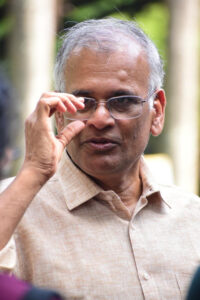
As Tamil literature prepares to enter a global conversation at the Living Tamil LitFest in New York, writer and thinker Jeyamohan reflects on language, tradition, translation, and what it means for a literary culture to travel. Ashutosh Kumar Thakur recently spoke to Jeyamohan.
Tamil is one of the oldest living literary languages in the world. Its classical corpus stretches back over two millennia. Its modern literature, however, has had to fight for oxygen inside its own home. In this conversation, Jeyamohan speaks with urgency and clarity about that tension. He reflects on what it means to bring contemporary Tamil writing to New York, how translation reshapes cultural memory, and why literature must create vision rather than simply perform dissent. Moving between myth, philosophy, politics, and personal experience, he outlines a project that is both literary and civilisational. This is not just about visibility abroad. It is about redefining how Tamil modernity understands itself, and how it wishes to be understood.
Q. Tamil is among the world’s oldest literary languages. What does it mean for its modern literature to arrive in New York now?
Jeyamohan: Yes, Tamil is one of the oldest languages in the world. This long tradition is both our wealth and our burden. In Tamil Nadu, many people believe that literature only consists of ancient classic texts, and they tend to apply the literary norms used for these classical works to modern writing. This perspective may explain why simple commercial mock epics like “Ponniyin Selvan” were regarded as modern literature in Tamil for two generations.
We have arguably some of the best modern Indian writings in Tamil, but we do not have enough readers for it. Pioneers of modern Tamil literature have been fighting for nearly a century to create modern aesthetics for writing and reading contemporary literature. This struggle is still ongoing. Almost all major creative writers here have written literary criticism, much like the old British masters. Can you believe that I have written nearly fifty thousand pages of literary criticism so far?
Our masters wrote in little magazines, and they never had more than a thousand readers. They never had major awards either. Using modern and cheap internet communication, we created a tiny renaissance in modern Tamil literature. We started a literary forum fifteen years ago, and we are honoring unsung masters of Tamil writing. Slowly this organization extended to the USA and Europe. Now we are extending our activities to introduce our literature to the world.
Q. Do you see this moment as an expansion of Tamil literature or a test of global literary frameworks themselves?
Jeyamohan: Yes, we plan to expand Tamil literature globally through this festival. But which globe are we referring to? In literature, there are many different ‘globes.’ One features writing filled with simple contemporary political discourses and social ideas, while another consists of consumer-oriented reading material. We present the type of global writing that shows the other sides of the world to every discerning reader, one that appeals to those who are dedicated to reading and understanding the depth of human culture and discovering the grand unity of the human mind.
Last year, my short story collection “Stories of the True,” which was already published in English by Juggernaut, was released in the USA by FSG publishing house. This year, FSG is set to publish my novel “White Elephant” in September, and before that, in April, my novel “The Abyss,” which was previously published in India by Juggernaut, will be published in the USA by Transit Books.
I traveled throughout the USA to promote my book and observed two distinct types of responses. The first came from young readers, particularly students from various third-world diasporas. The second group consisted of Indian children who were born and raised in the USA. Both groups read the book and engaged in serious discussions about its themes. They expressed a profound quest for their cultural identity and felt the need to develop their own sense of justice in relation to it. This reflects an emerging issue in the USA today.
The reception of this book inspired me to present the entirety of modern Tamil literature to the literary community in the USA. I understand that gaining a place in the global intellectual arena is not easy; it involves navigating numerous complexities and conflicts. However, we are doing our best to make our presence known.
Q. Modern Tamil writing was born through rupture and dissent. Does global visibility soften that edge, or sharpen it?
Jeyamohan: In fact, ‘dissent’ is a minor factor in literature; sometimes literature arises from dissent, but its function and mission cannot solely be dissent.
I will make a bold statement: the primary challenge of literature is to ‘create’ the culture and the history. Generally, a period or a society has no natural connection with the past or future. Art and literature are actually creating these connections. It is obvious that in our lives, there is absolutely no inherent connectivity between events, moments, and days. Only our memory creates the connectivity. Art and literature are the ‘memories of humanity.’ History and other forms of knowledge emerge from literature and are ultimately transformed into literature.
As an ancient society, the Tamils face a challenge: they should present their magnificent past, both its glory and its flaws. They have to create connections between the past and the present while also nurturing visions for the future. While dissent plays a role in this process, the primary task is to reimagine the entire culture. I believe that all truly great writers are creators of culture and history.
We have two distinct cultural memories: one rooted in the Indian tradition and the other in the Tamil tradition, each with its own unique characteristics. This may explain why I wrote “Kottavai” and “Venmurasu” simultaneously. ‘Kottavai’ offers a fresh interpretation of Tamil mythology, presenting the story of Tamil culture in a contemporary context. In contrast, “Venmurasu” retells the Mahabharata in a modern format, using pure Tamil without using Sanskrit words. Yes, there is dissent in those novels—spiritual, cultural, and political—but their task is bigger.
I understand your perspective; in India, there is a tendency to cater to Western tastes in literature. Writers often simplify complex issues, adopt Western narrative styles, and provide excessive verbal explanations and one-sided arguments, often at the expense of aesthetic considerations.
It is quite natural that writers who present simple political correctness become popular among ordinary readers. Generally “Dissent” is their term; they use it to describe their simple criticism of Indian culture and society. See, dissenting against one of the oldest and largest living cultures is not a simple task. To do so, you must face the wholeness of Indian culture, which is created by the great epics. You have to re-narrate them; you have to create an entire new culture collectively.
Yes, I understand that plain Indian writing with overt social commentary is often welcomed by general Western readers and critics who prioritize simple humanism over aesthetic and cultural elements. This trend is also evident in Tamil literature, which is known outside Tamil Nadu. I recall that Thomas Meaney, while editing a special issue on Indian literature for Granta magazine, strongly addressed this issue.
As a strong but small literary movement, we are striving to present ourselves authentically to the world. We understand that it may not be easy for the average Western reader to grasp the nuances of our literature, but we hope that serious readers exist everywhere. They can connect with the spirit of our writing.
In response to a question at a college in the University of Southern California, I said, “You have to put in some labour to understand me because we have laboured for two centuries to understand you.”
Q. When a literature moves far from its social soil, what survives first, form, ethics, or memory?
Jeyamohan: I would say this firmly: ‘vision.’ I know in certain circles of postmodern literary criticism that word is not very much appreciated, but the era of postmodernism is gone, and this is the era of transmodernism. I consider myself a trans modernist, as David Foster Wallace put it.
I believe constructing values and imagining visions is the main function of literature. Great visions could be expressed only through deep metaphors that emerge from dreams, and when they meet language, they become an aesthetic form. Vision, metaphor, and aesthetics are the three elements that cross language barriers and reach every human mind, because they are humane.
Q. At this festival, Tamil is largely mediated through English. Is translation, for you, loss or renewal?
Jeyamohan: Yes, of course, there is a loss in any translation. However, reading occurs in the reader’s imagination, and language serves as a vehicle for that imagination. In fact, reading is itself a translation; we are converting a linguistic form into our experience. A good reader can easily fill the gaps of translation and imagine the feel of the original.
We read almost every master of European language through translation. In fact, I have read many Russian masters through very poor translations, yet their works conversed with my soul. We also expect to attract serious literary readers from around the world.
Q. Are there elements in Tamil writing, silence, moral transition, cultural instinct, that resist translation entirely?
Jeyamohan: Always something resists translation; it is called the style. I am celebrated for my style in Tamil; it cannot be translated into other languages. Tamil is a language with many layers: a semi-tribal protoclassical period, a classical period, a Bhakti period, and a modern period. We have a big folk tradition and nearly seventeen distinct accents. I am considered a scholar in ancient Tamil, and I used a lot of folklore also. I created different styles for each major work. Similarly, every major writer in Tamil has his own style and cultural ground that could be lost in translation.
But again, a good reader can easily transcend the barrier of translation and touch the original style.
I used to wonder one thing: Constance Garnett translated Dostoevsky and Turgenev into her same stale language, but even at the age of twenty I could grasp their different styles in the original.
Q. Many younger readers encounter Tamil literature first in English. Does this change how the tradition is inherited?
Jeyamohan: No, in fact, it added more colour and intellectual integrity to Tamil. Now, I have nine English translators, all of whom completed their studies through English and discovered modern Tamil literature only after their thirties. They read extensively in English, yet they still felt a strong desire for cultural authenticity and aesthetic satisfaction. Then they found Tamil modern literature; they are writing and translating.
Literature is actualized in language, but the real experience of literature is beyond language, in the cultural memories of mankind.
We have to understand one thing: throughout history our masters have been naturally bilingual. They had a natural language and a connecting language. Once upon a time Sanskrit was the connecting language, and now it is English. These languages are actually opening the outer world toward us and enhancing our vision as human beings.
Q. Should writers feel responsible for that first encounter, or should literature remain indifferent to readership?
Jeyamohan: Well, I can answer only through my experience in Tamil. When I started to write in Tamil, I was writing only in little magazines printed only two hundred copies. But that was not an indifferent circle; they were ardent readers, and we used to discuss literature very seriously. Can you believe that I used to write nearly a hundred letters in a month?
Then I started a little magazine for myself, which I named Sol Puthithu. Then the internet came, and I used it. In 2007, I launched my own website, which is uploaded daily. (For the past 18 years, it failed only one day for technical reasons.) Nearly fifty thousand readers are reading it every day, and it is the best and most popular literary magazine in Tamil today.
I published almost all of my novels and short stories in it without any price. It created a worldwide readership for me, and my readers formed the Vishnupuram Literary Circle in India and abroad. We are conducting three Lit-Fests annually for serious literature and giving three major awards. We are editing a free online encyclopaedia for Tamil culture (Tamilwiki). Now we are conducting the New York LitFest.
Within fifteen years, we emerged as a cultural movement. We formed various sister organizations and are conducting village development programs and educational missions. We created an institution named Unified Wisdom to promote philosophy and literature. We purchased our place at the hill station and built a Gurukul-type institution there, where we conduct classes every weekend.
I would say this to a writer: don’t go towards the reader, never try to entertain him, never become a seller of words, take writing as a mission, pull the readers towards you, and create your own readership. That is the way of great classicists of the world.
Q. Your work spans fiction, philosophy, and myth. Are you read differently outside India?
Jeyamohan: I am also a great reader of popular science books. My primary interest is Indian philosophy and history. I have a deep interest in the prehistoric world, so I used to travel extensively outside India to see ancient monuments, particularly Stone Age remains like cave paintings, petroglyphs, and menhirs. In fact, I am answering this question sitting in a place where there are a lot of ancient Stone Age remains.
Q. Do you value misreadings when your work travels across cultures?
Jeyamohan: Misreadings are natural, and literature somewhat encourages them. Misreading is a way of appreciating and appropriating literature and philosophy; it enhances the imagination of the reader. Human culture exchanges our dreams through literature, and misreading is a way of creating a new dream from an existing one.
I would say this: Tibetan Buddhism is actually a grand misreading of Buddhism, but it is unique and a great treasure of mankind. Another interesting example of misreading is the Theosophical Society of India; they misread the entire Hindu culture and mysticism, but they created their own vision. The human culture across the world flourished through this kind of misreading.
Misunderstanding is fundamentally different; it often involves pettiness or a malicious intent. Generally there is nothing cultural in it; it is more political, more connected with power. Actually, literature is a relentless fight against the misunderstanding created by the conflicting sides of power throughout history.
Q. Tamil literature has always been entangled with caste, power, and social conflict. Do these concerns risk becoming “context” abroad?
Jeyamohan: See, caste is everywhere. Even untouchability was there in France and Japan. Discrimination and subjugation based on birth are the core ideas of the caste system.
Even in the USA today, a very obvious caste system prevails. In the USA, the Blacks are comparable to Dalits, and many still reside in slums. I faced some kind of discrimination in the USA and Britain while travelling. After reading my “Stories of the True,” one American student from Ethiopia held my hand with tears. She can easily identify herself with the core problems of caste here.
Power and social conflict are everywhere, and literature is always fighting against them. Just imagine, I am still reading Tolstoy; the power system and the social struggles of his time are nowhere now. The work still resonates with my soul because its spiritualism is timeless. Conflicts and the struggle are time-bound and regional, but the human spirit for justice and freedom is timeless and universal.
Q. Can literature retain its political seriousness when removed from its immediate social pressures?
Jeyamohan: The politics of a literary work are actually created by the reader. For me, the Mahabharata is the best political work of India. It is more useful to understand the current politics of India than any modern works. Ultimately, what is its power struggle? The Brahmin and Kshatriya alliance ruled Aryavartha. The newly emerged Yadhava power compromised with the Dalits (asuras) and defeated them, didn’t it?
Creative writing is not propaganda material. A writer is not a politically well-educated man or an activist; if he is writing politics directly, he is actually echoing the ideas of someone else. Then why should I read him? I would rather read the original voice.
A writer’s mission is creating cultural memories and dreams through renarrating and rearranging life in language. Yes, it will naturally contain political elements, and readers can interpret it in a given context. Personal political views should not influence a writer’s writing; if they do, the writing will lack authenticity.
Good writing emerges from immediate realities, but it creates something timeless, and itsworth is decided by that perennial thing only.
Q. Literary festivals often privilege speed and performance. What does literature lose in such spaces?
Jeyamohan: Generally a festival is the best way to get into any art form. The festival mood pulls new people in to art and literature.
There are two types of literary festivals: one type is similar to the ones we organize, while the other type is a large event funded by big financial resources.
We organize our festivals with the funds of our friends and readers. We focused solely on serious literature and also restricted the number of participants. So serious literary discussions are becoming possible, and any literary enthusiast can directly jump into the main flow of literature through attending just one festival.
Big literary festivals are offering another kind of experience; they are showcasing writers and books. They are presenting world literature as a whole. Yes, they have many limitations. They must have large funds. For that, they must find sponsors. To satisfy sponsors, they should show a crowd. For that, they have to present commercial and popular faces.
In almost all Indian festivals, we can see the same faces again and again. They are repeating the same ideas at every festival, using the same phrases. However, they draw large crowds. Therefore, our major literary festivals primarily promote superficial popular reading. But they are pulling new readers into the world of books. They are creating a celebration mood for book lovers. A good reader can find his way through books toward serious literature.
Q. And what does it regain when conversation is slow?
Jeyamohan: I always believe in the quest and intuition of readers. I am not presenting this as an idealistic statement. As I said earlier, I have created my readers, assembled them, and together we have become a global phenomenon. I would say: picture your ideal readers and speak to them; they will come from the culture. The intensity of the writing will bring the readers, for sure.
Q. How does one speak of tradition in a global city without turning it into nostalgia?
Jeyamohan: Well, nostalgia is not a negative word in literature. Jorge Luis Borges once said that we are living in a world that is already burnt down and turned into ashes. You can see this element in almost every Latin American writing; nostalgia is the key emotion that created them. (And Salman Rushdie is imitating that writing style without any nostalgia, which is why his works are flat and just a simple play on language.)
The word “nostalgia” has some different meanings in literature—it is not longing for the past or having meaningless pride in the tradition; it is converting the tradition into images and metaphors—that is also a quote of Borges. We can talk about perennial things only through ageless archetypes, and they are in the tradition only. Without deep passion, you cannot recreate the past as present-day dreams. Literature is a device to connect the past with the future through contemporary narration.
Today the consumerist world is making us its producing and devouring units. Connecting with the past is the way to dream about the future. We became dreamless people. Dream can only save mankind today. I believe the Tamil and Indian traditions have a lot to contribute to the dream of modern man.
Q. Is there a single Tamil work you would want a first-time global reader to encounter today?
Jeyamohan: Well, I am confident enough to say it is my novel, Kottavai—it is yet to be translated.
Q. Finally, do you imagine the future of Tamil literature as rooted in place or shaped by movement and translation?
Jeyamohan: Translation is always a natural way of active literature. Translation in both ways, from and to. Just look into our tradition; both our literature and religion are actually created by translations. Kamba Ramayana is the pinnacle of Tamil literature and it is a kind of translation. The entire Shaiva Siddhanta tradition emerged from Meykandar’s translation of the first chapter of Raurava Agama. The entire modern Tamil literature was created from efficient translation of classics from European languages.
Now we are posing for outward translation to ensure our place in the global literary field.
(Ashutosh Kumar Thakur is a writer, literary critic, and curator based in Bangalore.)