Dear Jeyamohan sir,
I have just come back from Vellimalai, and before the feeling fades, I felt like writing this. Just to share what stayed with me.
This was our second visit to Vellimalai for bird watching—my daughter and I. At home, my parents and wife kept asking, “What is there to see again?” We tried to explain, but somewhere along the way, we realized—how do you explain something like this?
We had begun preparing a couple of days in advance. My daughter was slightly skeptical this time—she wondered if she would find like-minded friends again, like she did during the previous visit. I assured her she would.
We only began amateur bird watching a year ago. If someone asks me what it has given me, I struggle to answer plainly. I struggle to answer plainly. It feels like something within me has been opened—like a new sense awakening.
Perhaps like someone who has lived in silence suddenly hearing the world.
The same home, the same streets—but suddenly, everything feels alive. The world feels fuller, as if it has always been brimming with life, and only now have i awakened to its wonder. For 35 years, I never truly heard a bird’s call, nor did I look at a tree to discover life within it.
Now, even if I am left alone in a place where small aerial life exists, I feel I could be at peace.
What makes this three-day program truly special is how quietly it connects Science , observations ,stories, memories of great naturalists, and gentle strands of philosophy—stitched together without insistence, without noise.
On the second evening, we stood before a coconut tree filled with Baya Weaver nests. We must have spent nearly 45 minutes just observing—watching the birds move in and out of their intricate homes.
It was a delight in itself.
But then, sensing our curiosity, Vijay sir recalled an observation by Salim Ali—about a weaver bird .He said that during his field days, Salim Ali had watched these Baya Weavers closely. Each male bird works quietly and tirelessly, weaving its nest strand by strand.
But among them, there was one bird that took a different path. Instead of collecting its own grass, it would quietly go to nests already built and pull out strands from them—stealing small pieces and using those to build its own nest.
Slowly, the other birds began to notice. And then, at some point, it is caught and confronted, after which it repents and gathers its own material, starting to build its nest by collecting its own grass.
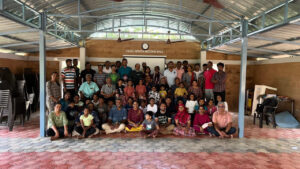
In that moment, what began as simple observation expanded into something deeper. He gently placed a question before us—about conscience, about righteousness in the natural world—and then, just as gently, he walked away from it. No explanations. No conclusions.
It made me wonder how do we understand righteousness? Even in human life, can we judge others purely within the boundaries of our own moral frameworks?
Easwar sir had cautioned us early not to see bird behaviour through our ideas of right and wrong.
Because it doesn’t just stop with birds. How often do we judge people, cultures, or beliefs through our own sense of morality, assuming it is universal?
Another learning was that in Ancient India, despite having great minds, we did not always cultivate the habit of documenting, categorizing, and sharing our observations systematically. Especially in Indian ornithology, we learned that this journey began very late.
Even today, popular science writing is not as mainstream here as it is in Europe or America. We dont have our own Carl Sagan , Neil de grass tyson in India
Vijay sir enthusiastically mentioned that it is for those in classrooms today to become future naturalists and popular science writers. Who knows—perhaps among these very children, there could be a David Attenborough, a David Lack, or a Gilbert White in the making. These programs may well be their first steps.
Another beautiful sight was the sheer enthusiasm of the elders. How often do we see grown-ups leap with joy at spotting a bird like the Racket-tailed Drongo or feel genuine disappointment when they miss it?
It reminded me of a line by Carl Sagan:
“Every kid starts out as a natural-born scientist, and then we beat it out of them.”
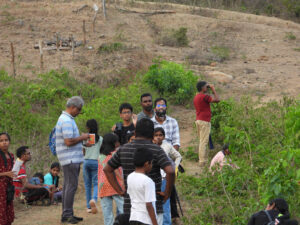
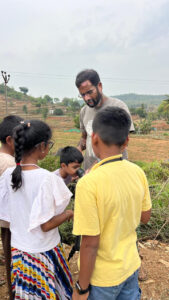
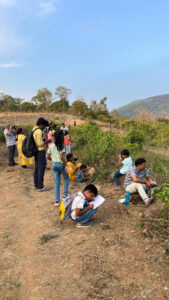
And with the kids, it was even more special. During the walks, you could see them guiding their parents—telling them where to look, how to wait. There was a quiet role reversal there.
Agalya, Niranjana, Shakthi, and almost every child—their curiosity and attention were something else.What clarity, what sharpness, what restless curiosity. As parents, it really feels like it is our responsibility not to let that fade away.
Watching them run around, speaking only of birds, keeping a favourite bird names to themselves was fun play and there was something deeply joyful, almost pure about it.
The session began with Peter Matthiessen’s thought:
“To know one living being completely is to know the entire universe.”
Yet, I was also reminded of Karunakara Rao from Visumbu, whose view feels almost opposite that even when we think we have understood something, the universe remains far too vast to truly grasp.
Perhaps both are true. To know something deeply is to touch the universe but to know it entirely is beyond us. Maybe this paradox itself drives us the urge to hold a small piece of understanding, feel its fullness for a moment, and then realise it is part of something immeasurable.
Still, we keep trying through science, philosophy, and poetry to experience even a fraction of it. And somewhere along the way, we become a little more humble.
On our way back, my daughter and I spoke only of what we had seen—people, moments, birds. She never once asked for her phone.
She also told “Appa, when Vijay sir spoke about Wallace’s integrity, his voice trembled with pride.” She added, “When he ended the session remembering M. Krishnan, his eyes almost shone with happy, emotional tears.”
Perhaps that is the greatest tribute to feel so deeply for those who walked before us and gave so much to nature, art, and literature
She also kept recalling Easwar sir his way of saying perumbalum (“mostly” in English) and even imitating him. Especially how serious he was about silence during field visits.
It was a deep wholesome experience. Thank you once again to Vijay sir, Easwar sir, Mani sir, and for the valuable insights from veteran birders Selva sir and Ramki sir.
Of course, we now return to our everyday routines—work, responsibilities, and the usual distractions of life. But programs like this feel like a quiet dream for adults a pause from the mundane and, more importantly, a seed of wonder for children.
We are already looking forward to the 15th plant watching program.
As parents, what more can we give our children than this an intimacy with nature, a way of seeing, a way of being?
Let there always be flight.
Yours Lovingly ,
Sivakumar Seenirajan & Mellina