Dear readers ,
Greetings,
this is a letter written by S Vaishnave about the bird watching camp which was held on May 1,2 and 3 at vellimalai. One thing that urged me to join the bird camp is their different nature, the beautiful colours, and the view of the mountains.
The first day was the introduction day, the class for 3 days was taught by Vijayabharthi and Eswaramoorthy sir. The first day they taught about how the bird evenly distributes its weight to fly more smoothly and effortlessly . Do you ever wonder why birds bend their legs backward ? That’s because it’s not its knee that is bent, it’s actually the bird’s ankle. This got into shape through their evolution .
Then we got the schedule for all the days . First we were informed that we would go to the field for observing the birds from 6 a.m. to 8:00 a.m, which was not followed for the first day . The morning class would begin at 10:00 a.m. and end then 1:00 p.m, in which 15 minutes would be spent discussing the birds we saw, whether a new or old one, we would pen it down and mark the birth attendance later. The next class was again field visit from 4:00 p.m. to 6:00 p.m. The evening classes were from 7:00 p.m. to 8:00 p.m. We had snacks often during the breaks. After 8:00 p.m. we would get our dinner ,during 1:00 p.m. 9:00 p.m. lunch is served . from 8:00 a.m. to 10 a.m. breakfast is ready. The food was excellent, the various foods included uthappam , upma, chapati and semiya.
In the first class there was a session about how to describe a bird we saw to an expert , like we have to compare its beak length with its head length and its colour what was it doing, any additional features like very long tail which the Pardes fly catcher [male] or a big crest on its head. And also they mention the fact that the smallest bird in the world is the male bee hummingbird which is just 1.9 grams and do you know why the birds have different colours? Mainly to camouflage which gives different benefits such as protecting itself ,for hunting and importantly to attract female birds. Females are usually dull while males are very colourful. They mostly intend to pass on their genes ,the female Bird chooses a male.
And an introduction to merin and ebird app was given. The merlin app was to identify the birds it had a sound ID in which we would record and the AI would guess which bird it is but there was a 50% chance that it would be wrong. There was a portal through which we could hear a bird song, then there was this picture ID etc. meanwhile the Ebird app also known as citizen’s science which is used to create a data table for the birds we saw in a particular place, this data is used by scientists for their research.
I liked the session about the cuckoo, it was fascinating to hear nature’s cheating .
The cuckoo placed its eggs on the word warbler’s nest ,the cuckoo modified its eggs to match the warbler’s egg. The cuckoo patiently waits near the warbler’s nest until it lays an egg. During that process, the cuckoo’s egg hatches one day before the others due to the prematuring process inside the mother’s body. The new born cuckoo,before opening its eyes, would push the other eggs in the nest down. This is due to the need for food , the mother equally distributes the food she brings to all her newborn babies. So to get the bigger portion , the new born cuckoo does it. The warbler, even though smaller than cuckoo, recognises it as its own child. because when a mother bird looks at a newborn baby bird, she would decide that it is her own child. And that’s why the warbler feeds the cuckoo even when it is fully grown.
The next class was about the various activities of birds. The most interesting thing was that some birds don’t sleep. The reason has an elaborate theory ,so it is that the bird’s brain is divided into two parts which are not connected. The right eye is connected to the left part of the brain and the left eye is connected to the right part of the brain. So a bird closes its one eye and opens the other. The brain which is connected to the closed eye sleeps while the other brain watches for danger.
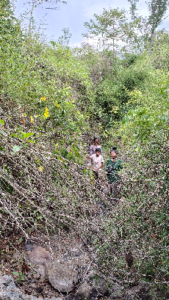
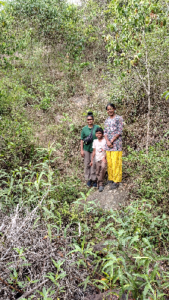
The field visit was also very good ,we would walk for 2 km and just observe the birds. We saw racket tailed drongo which was very rare and heart spotted woodpecker which we could not see for almost 5 years. The evening session was story time, the narrated a famous story written by Sir JeyaMohan, visumbu. The story revolves around the theme of migration and scientific research where a man changes the migrational courses of birds which disturbs the balance of the ecosystem and also the fish get disturbed.
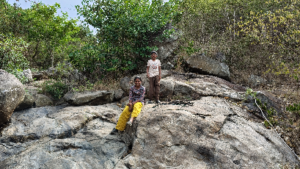
In our free time we would go to the waterfall. This time we went with Madam Kiruba , who is a publisher. We all went inside the waterfall and to our surprise we found a big Tailor bird’s nest. It was so peaceful and very quiet there that no one t would disturb anybody.
This bird camp was a very good experience to learn more about birds and their nature.