Dear JeMo
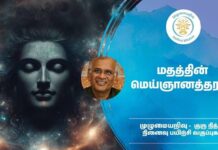
Attended your session ‘Introduction to Indian Philosophy, on Jan 2 to 4, 2026. Writing this in English as the session was in English and am slightly more comfortable writing in it as compared to Tamil. As mentioned in my earlier email after Temple Architecture, you’re doing impressive work that typically requires an institution or government (unfortunately there are not many or probably not any here!).
Summarizing the thread of thoughts you shared with us along with my understanding of Ramakrishna Vivekananda school of Vedanta and bit of experience in Advait Vedanta. While bhakti movement has attracted the masses and has ruled the Indian space from around 12th century CE, a rational mind has lot of questions and unless they are logically answered it can’t delve itself into any meaningful path. On the contrary, one who has understood the Advaita concept well viz., “There can only be one reality” or “There can’t be two or multiple”, it’s easier to worship the same one, call it God, Brahman, Shiva, Allah, Jehovah or whatever in the form of an idol or particular space or thru’ an animal or fire etc. For some like Ramana Maharishi, whose mind is so find tuned, just by understanding the concept, they are able to get the realization. For others, it is a life long struggle (or if one goes by Indian belief system, many lives). But ultimately one will realise – all this, the world, this life or next life, everything is only an illusion and there is only one and that one can only be described indirectly by philosophies but can’t be directly explained (unless probably the teacher is Sri Ramakrishna and the student is Narendra, where Ramakrishna by the touch could pass on realization).
Classification of Advaita Vedanta (or Uttara Mimamsa) as “Qualified” Srutivada by Nitya Chaitanya Yati (his word “Limited” changed into “Qualified” by you) stating it as the Middle Path of Indian Philosophy is a unique thought as compared to traditional way of classification as “Srutivada”. There was great insight in identifying the Indian philosophical systems with the modern classifications of knowledge viz., Samkhya to Ontology (Study of what truly exists); Yoga to Intuition, Vaiseshika to Epistemology (Study of how we know what we know), Nyaya to Logic, Purva Mimamsa to Philology (study that deals with structure and development of languages) and Uttara Mimamasa / Vedanta to Phenomenology (study of subjective experience).
While one can think all this is only bookish (though very essential to remember every detail), there was experiential knowledge in the way in which you explained the “Nasadiya Sukta” on a misty cold morning under the tamarind tree. It was great to learn how thousands of years ago, one could understand the truth and also express it so beautifully (that last line like “…even It may not know” is unmatched).
We also learnt that wisdom is beyond any boundaries or restrictions and wherever we find it, we need to embrace it, be it Indian, Western or Indian thought explained to us again by Westerners etc., and always try to look at only the positive side of it. We need to look at persons like Monier Williams, Max Muller etc., as modern rishis as Swami Vivekananda suggested and not with suspicion.
Eager to attend the next levels.
Warm Regards
S Ravichandran